
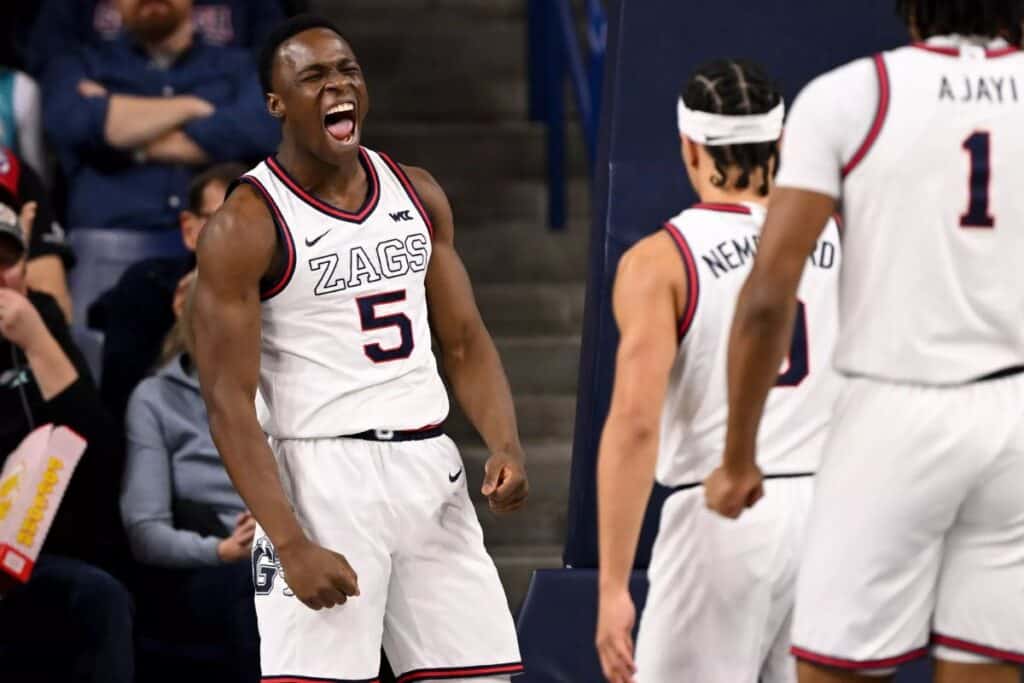
Emmanuel Innocenti is somewhat the mirror of Gonzaga. Unassuming, not flashy, low on media hype, but always a protagonist in the end. The same goes for a program that’s reached March Madness for 26 straight years and often does so as the No. 1 seed among final title contenders. There’s not much talk this year about a Bulldogs version that’s lost just one game—against Michigan—and sits at No. 6 in the AP Poll. Maybe it’s the lack of a star freshman, or leader Graham Ike being sidelined, or the usual narrative about a weak WCC, but in Spokane, they’re hoping everyone forgets about the Bulldogs so they can make them pay dearly for that amnesia come March.
“The goal we’ve set for ourselves is something we already know – we don’t say it out loud and we shouldn’t focus on it too much,” Emmanuel Innocenti explains to us. We reached out to him again – after our summer chat – to get the details on his solid starting season at Gonzaga, the Bulldogs’ form, and more about one of Division I’s most storied programs.
Back in June, we titled the interview “I’ll convince everyone that Gonzaga is my place”. Now that we’re in February, there’s no doubt left about your role in the rotation of a contender.
Yes, when we talked last summer, it was more personal. I wanted to prove I could contribute meaningfully to the program. Things are going well—I can’t complain. The team’s 21-1. It couldn’t be better. Physically, I’m good; the vibe is calm, and I’m tight with my teammates. My shooting could improve, but I’m happy with the situation.
You started in the starting lineup, then came out to make room for late arrivals like Spaniard Saint Supery or Tyson Grant-Foster, who’s back now: Does your impact change depending on whether you start or not?
No, I know my role well—I know what I bring defensively or offensively to the team. What matters is when I’m in. I know the team needs me for defensive stops, and I’m always ready for those key moments when someone needs help with foul trouble. In today’s basketball, starting or not doesn’t matter. What’s important is contributing your best when called upon.
Great sitting down with Gonzaga’s trilingual defensive specialist Emmanuel Innocenti. He says you can feel the energy on campus ahead of Saturday’s tilt with Saint Mary’s.
“The vibe around town and in the gym is different. It’s a big game and we don’t want to lose at home.” pic.twitter.com/MI22LY387w— Andrew Quinn (@andrewquinny) January 28, 2026
Let’s talk about your game: Defensively, you’re a game-changer—a Gonzaga blog even called you the best defender in all of college basketball. On-ball, you’re tough to beat: Tell us about your defense.
I got into defense around 15-16 years old. I saw a Kawhi Leonard video with the Spurs and was blown away. I told myself, “I want to be like that, play like that.” From that age, I focused on it. It also let me show I could do something others couldn’t or wouldn’t. I’ve honed my defense more and more— I love it. I pay close attention to details and try to improve daily, bringing something new. Gonzaga dictates tempo and pressures the ball hard, forcing opponents into what we want and uncomfortable spots. We’re compact defensively—everyone knows how to do it. If someone slips, they know the others have their back.
In Italy, there aren’t many bigs with size, so we use physical, athletic players near the basket. That happened to you at Stella Azzurra too, though not anymore at Gonzaga—but how much of that big-man experience did you bring to America?
My Stella years helped me tremendously on defense. In my first A2 season, we lacked a true 4, so I filled in there, then played 3, even some 2 minutes. It was key because I learned to guard 1 through 5—I can handle post players since I’m used to it. Here in practice, coaches sometimes use me at 4, especially now with injuries, needing someone physical who defends on-ball and in the paint. I often guard our guards in drills, the ones working on their offense who need a tough defender like me.
Your game increasingly resembles so many NBA role players: How do you view the league upstairs, and how is Gonzaga helping you?
The NBA has always been my goal—they love 3&D guys. I’m confident defensively; I’m set there. My shooting needs work. I started the season strong, now in a slump, but I’m grinding back. Not just for me—the team needs it, especially without bigs so we can drive more and kick to the perimeter. I have to be ready to knock down those shots. For the NBA, to be a role player, I need solid percentages.
Nembhard dishes it to Emmanuel Innocenti for the corner 3! 🤩 @ZagMBB pic.twitter.com/mJjAp4DV4Q
— FOX College Hoops (@CBBonFOX) December 28, 2024
Last summer, you talked about your individual shooting work. How tough is it now to carve out time for self-improvement amid classes, game prep, and travel?
There are tons of commitments now between school and practice. Improvement comes more in-game, within our system—reading situations in practice for shots or drives. Individually, I train evenings with managers who help on shooting and reading plays. It’s different—summer gives you the whole day.
21-1 and Gonzaga’s usual dominant season, though it feels like less buzz than past years: Is that just our perception, or do you guys feel a bit “snubbed” in America?
It doesn’t faze us much. In the summer, we all sat down, set our goals, and promised that nothing outside the locker room would affect our play. Talk about us, whether they like us or not—it doesn’t touch us. We’re focused on personal and team improvement and what we can do. We work toward our goal.
What kind of team is this Gonzaga?
We’re in a great spot this season—not easy to be 21-1 at this level. There’s tons to improve, and little time—March is close, so we tweak small details. Playing without bigs might help; switching lineups vs. opponents could too. We have ups and downs but stay locked in and adapt. It’s crucial—the coaches are happy with our work. But we know we need a few more steps for our goal.
Do you prefer playing with two bigs or just one? How does the team’s setup change your game?
With two bigs, it’s simpler—you dominate inside and out. But with our roster, we can go small: elite guards who defend 1-4. Some guys haven’t gotten minutes behind vets—this is their time to prove they belong.
Top 10 Non-HM Euro Juniors in NCAA D1:
1. 🇱🇹 Paulius Murauskas
2. 🇷🇸 Andrija Bukumirovic
3. 🇩🇪 Jake Ensminger
4. 🇸🇪🇺🇸 Nils Cooper
5. 🇫🇮 Miro Little
6. 🇷🇸 Lazar Djokovic
7. 🇩🇪 Kilian Brockhoff
8. 🇩🇪 Rikus Schulte
9. 🇮🇹 Emmanuel Innocenti
10. 🇪🇸 Conrad Martinez pic.twitter.com/XEoxp2BwZI— Rob Karaznevic (@dogtheballer) December 16, 2025
Against San Francisco, you defended great, but the Dons shot 50% from three on nearly 30 attempts. How hard is it to guard teams on fire?
At this level, expect anything—every team gives 120% to beat you, like you do them. They were hot from three. We held them down in the first half. Second half, we lost a few threes—over-helped on some. But you learn from it. Vs. them, force more drives, don’t help as much. Without bigs now, perimeter D is easier since we’re all similar height—so forcing drives will be simpler. Key lesson—we played well, just lost focus late and made bad calls.
Tell us about the Vegas trip: Epic wins over Alabama and Maryland, a blowout loss to Michigan. What kind of team are the Wolverines?
Big trip due to the competition level—early season, testing ourselves vs. top teams. First two were convincing at our pace. Michigan went how it went, but crucial to see what failed. They’re physically dominant, compact and united defensively. Everyone knows their role—they’re in sync, no forcing. Their mentality shocked me: tough, dictating play. So many passers who create for self and others—tough to guard. Shot lights-out, attacking the rim well.
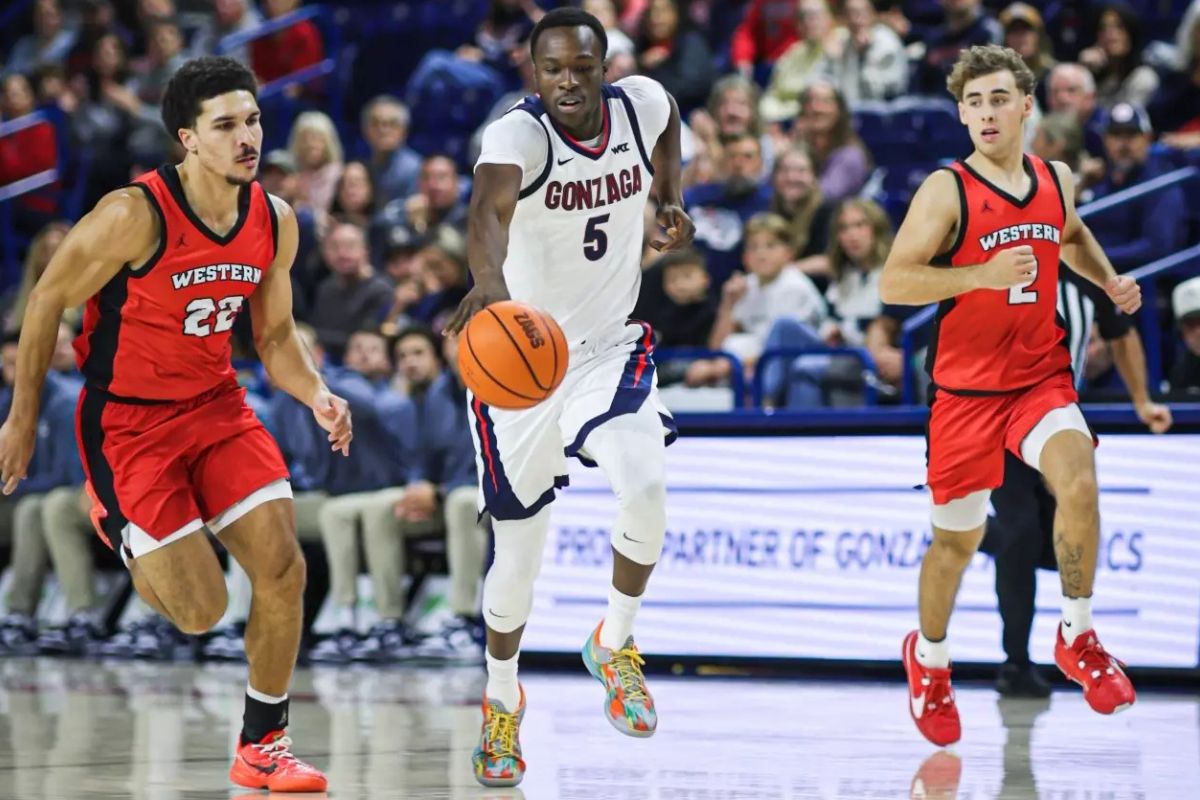

Before this interview, we were chatting about Arizona-BYU. During the year, do you find time to watch and scout teams you don’t play but might face in the tournament?
We’re locked on our schedule, but we do team nights watching games on TV. Like Arizona-BYU—fun watches where you learn about yourself, gauge levels, compare. Arizona impressed defensively—they’re title favorites. Michigan too, as I said—the two strongest.
You’re WCC favorites this season—everyone has you as champs by default: Negative or positive pressure?
Contrary to what people think, the WCC isn’t easy. We start favored, but the level’s high—everyone’s improving. They all bring 120% vs. us. No pressure this year—we’re chill and focused.
You play Saint Mary’s on Saturday: How’s prep going?
Big game, strong rivalry, but we prep like any other. Focus on their strengths—we’re dialed to win. A week since San Francisco, so normal prep. Time’s short with frequent games, so lots of film: fixes, improvements, limited court time. Light practice, more concepts—defensive spots, their D, attacking them. We have our scout sheet.
Any March Madness talk yet and what you can do?
Not much—we take it game by game. We know our goal—don’t say it, don’t obsess. Right now, win to get the best seed.
Last question: You have one eligibility year left. You’ve carved a solid role at Gonzaga, but we talked NBA. Summer plans?
Super focused on the season now. But I have folks like Andrea (my agent) who’s sharp, knows what’s best. That’s for next summer.